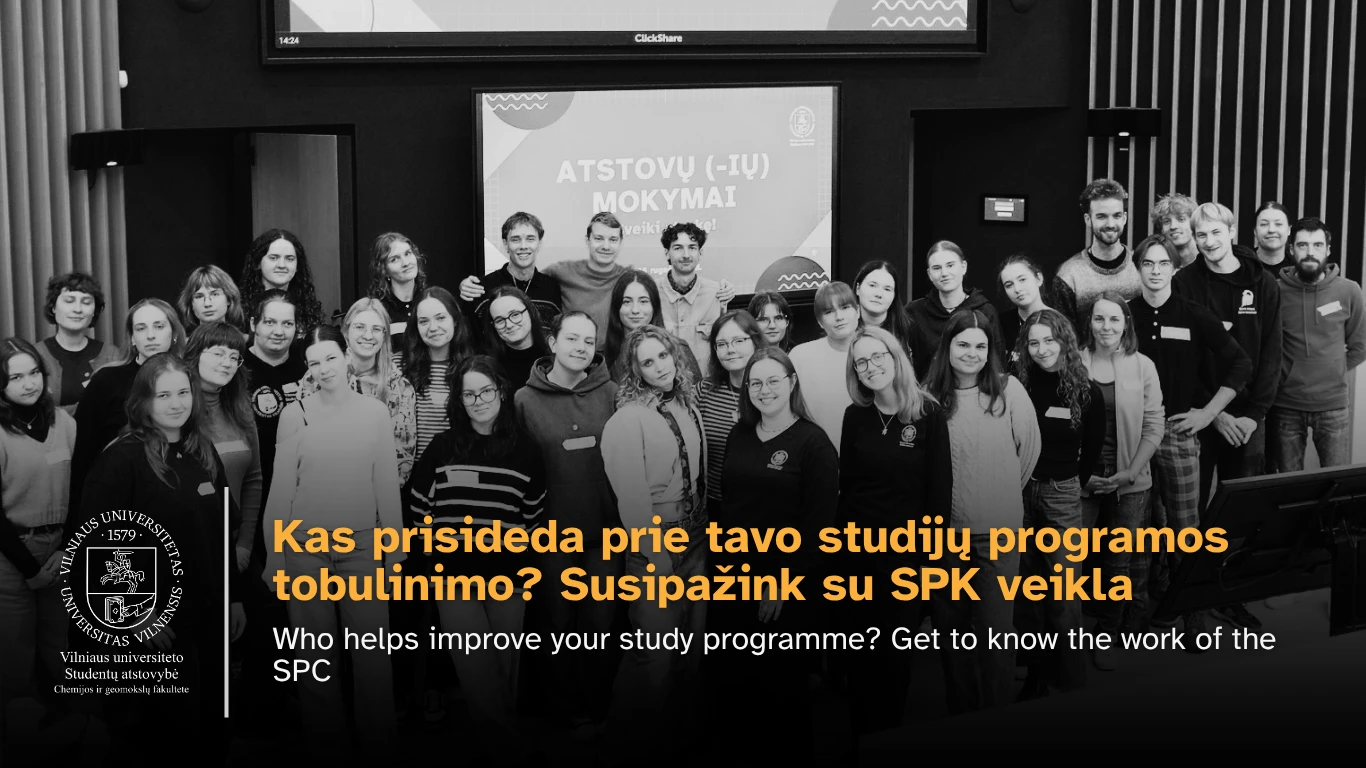
Who helps improve your study programme? Get to know the work of the SPC
Reading size
Have you ever wondered who decides what you study, how you’re assessed and what skills you gain? The Study Programme Committee (SPC) helps. What does it do, and how does it change your studies?
What is the SPC and what issues does it address?
The Study Programme Committee (SPC) is an academic body at Vilnius University (VU) responsible for coordinating, overseeing and improving a study programme. At the Faculty of Chemistry and Geosciences (FCHG), there are committees for individual study programmes, and several related programmes may be coordinated by a single joint SPC. Committees are made up of lecturers, social partners and at least one student representative delegated by VU SA FCHG, while joint committees include at least two student representatives.
The committees discuss matters related to the content and relevance of course units, the distribution of the study workload, and teaching and assessment methods. They also evaluate whether the competences developed in the programme meet academic requirements and the needs of future professional practice.
“Every semester, the results of student surveys are discussed very seriously. They are genuinely taken into account, and based on student feedback, we strive to implement the necessary changes.” emphasises Atėnė Petrikaitė, Representatives Coordinator at VU SA FCHG.
What is the role of student representatives in the SPC?
One of the most important tasks of student representatives is to stay in touch with the students of their study programme and find out which issues matter to them. To do this, they use student feedback, survey results and direct communication. The information gathered helps to better understand the challenges students face and the changes they expect. Student representatives present these observations at SPC meetings, discussing the issues raised with other committee members and looking for possible solutions.
“It is important that every student representative does not limit themselves to their personal opinion, but represents the interests of all students in their study programme. To do this, it is essential to communicate with students constantly, find out their needs and collect feedback.” stresses A. Petrikaitė.
How do SPC decisions turn into change?
Improving a study programme begins with an identified problem or a submitted proposal. Once student feedback has been collected, a relevant issue may be added to the agenda of an SPC meeting. At the meeting, the situation is discussed and possible solutions are considered.
For example, if students notice that the same topics are repeated across several course units, or that the content of certain courses is no longer relevant, they can inform their representative. The representative can then raise the issue at an SPC meeting, where the committee would consider how to update the course content or better coordinate the topics covered in different course units.
However, an SPC decision alone is not enough to implement every change. The committee can approve new or updated course descriptions, but fundamental changes to a study programme — such as those concerning its title, credit volume or other key aspects — require additional coordination with other university units. For this reason, some changes may only be implemented in later semesters.
“It is especially important that this process does not end with simply raising a problem or submitting a proposal. Students must be informed about the decisions made, the planned changes, and when and how they will be implemented.” says A. Petrikaitė.
How can students contribute to improving their study programme?
You don’t need to be an SPC member to help improve the quality of studies. If you notice a problem or have suggestions, you can contact your study programme’s student representative. It is important to describe the situation as specifically as possible and explain what could be changed.
Another way to share your opinion is through the course surveys conducted at the end of each semester. Even a small observation can become the first step towards meaningful change.
You can find your study programme’s student representatives on the VU SA FCHG website, in the “Student Representatives” section.


